
Dramamine
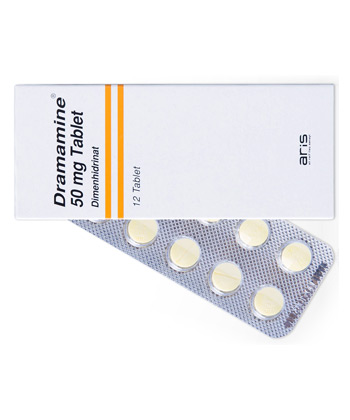
Dramamine
- In Canada, Dramamine (dimenhydrinate) and related products are generally available over the counter without a prescription. It may also be purchased in pharmacies, drugstores, and some retailers; availability can vary by strength and product form.
- Dramamine is used to prevent and treat motion sickness, nausea, and vomiting, including symptoms related to travel, vertigo, and inner ear disturbances. It works by blocking histamine H1 receptors and reducing signals in the brain’s vomiting centre, which helps decrease nausea and dizziness.
- The usual adult dose is 50 to 100 mg every 4 to 6 hours as needed, with a typical maximum daily dose of 400 mg. For children, dosing is weight-based and should be carefully measured according to the product label or a healthcare professional’s advice.
- Dramamine is available as oral tablets, chewable tablets, oral solution for children, and in some regions as suppositories or injection forms.
- It usually starts working within about 30 to 60 minutes after taking it, so it is best taken before travel or exposure to motion.
- The duration of action is usually about 4 to 6 hours, and repeat dosing may be needed during longer trips if directed by the product instructions.
- Avoid alcohol while taking Dramamine, because alcohol can increase drowsiness, dizziness, and impaired coordination.
- The most common side effects are drowsiness, dry mouth, blurred vision, dizziness, and headache.
- Would you like to try Dramamine without a prescription?



Basic Dramamine Information
- INN (International Nonproprietary Name): Dimenhydrinate
- Brand names available in Canada (English): Gravol
- ATC Code: A04AA05
- Forms & dosages: Tablet 50 mg; chewable tablet 25 mg, 50 mg; injection 10 mg/mL; suppositories 25 mg, 50 mg; oral solution 12.5 mg/5 mL
- Manufacturers in Canada (English): Church & Dwight (Gravol)
- Registration status in Canada (English): OTC, regulated as Gravol
- OTC / Rx classification: Generally over-the-counter for adult formulations; paediatric or higher-dose/IV forms may be prescription-only depending on local regulations
Availability And Price Landscape
Looking for dramamine in Canada usually means looking for Gravol, not the U.S. brand name itself.
That is the name most shoppers recognize on Canadian shelves, especially for dimenhydrinate motion sickness pills and other travel sickness medicine formats.
At major chains such as Shoppers Drug Mart, Rexall, Jean Coutu, and London Drugs, shelf presence is common, but the exact selection changes by province and store size.
Some locations carry tablets, chewables, liquid gels, and suppositories, while children’s liquids may be less consistently stocked.
Licensed Canadian online pharmacies may also stock dimenhydrinate, but provincial rules and pharmacist oversight can affect what is available for order.
Cross-border U.S. shopping is common when people compare motion sickness tablets, yet Canadian buyers should verify Health Canada compliance and product legitimacy before purchasing.
For price, small travel packs are usually the cheapest entry point, while family-size boxes often give better value per tablet.
| Package size | Typical use | Common Canadian price range | Notes |
|---|---|---|---|
| Small travel pack | Weekend trip, flight, ferry | Lower end of the shelf range | Convenient for one-time travel sickness use |
| Standard box | Occasional family travel | Mid-range | Often the best balance of value and portability |
| Family-size box | Repeated use over several trips | Higher upfront cost, lower cost per dose | Often preferred for households that keep Gravol on hand |
For most OTC dimenhydrinate purchases, Canadian patients pay out-of-pocket.
Provincial drug coverage usually matters more for prescription items than for a common antiemetic sold over the counter.
Canadian Patient Insights And Satisfaction Levels
What do Canadian travellers say when they compare notes online?
Across Reddit Canada, HealthBoards, and AskDocs, the same real-life situations come up again and again: ferries in British Columbia, cruise days, long road trips, and flights that start early in the morning.
Many people search for “Dramamine” first, then report that they end up buying Gravol in a Canadian pharmacy.
That brand recognition matters when someone is packing for a trip and wants something familiar at the checkout.
- “Worked fast for my ferry ride.” Many patients describe quick motion sickness relief.
- “It helped the nausea, but I got sleepy.” Drowsiness is the most common complaint.
- “My mouth felt dry the whole trip.” Dry mouth comes up often in reviews.
- “I was too sleepy to travel.” Some travellers avoid it for daytime use.
- “Chewables were easier to carry.” Convenience matters on flights and day trips.
Canadian users often split into two camps.
One group prefers chewables or liquid gels because they are easy to take on the go.
The other group avoids dimenhydrinate when they need to stay alert, especially if they are driving or managing children.
Product Overview And Brand Variants
What is the actual medicine behind the name on the box?
The International Nonproprietary Name is dimenhydrinate, and that is the ingredient doing the work.
In Canada, the best-known retail brand is Gravol, which is sold in several forms including tablets, chewables, liquid gels, and suppositories.
That is where the search gap starts: many Canadians still type “Dramamine,” but pharmacy shelves more often show Gravol.
- INN
- Dimenhydrinate.
- Brand name
- Gravol in Canada.
- DIN
- The Drug Identification Number that helps confirm a product is licensed in Canada.
- OTC
- Over-the-counter adult oral dimenhydrinate products are generally sold without a prescription.
A valid Health Canada approval and DIN are important markers for Canadian buyers.
That does not mean every form is identical, though.
Some higher-dose, injectable, or child-specific products can vary by market and province.
For people browsing online, a Canadian pharmacy listing with a DIN is a much safer starting point than a random marketplace seller.
Indications In Local Canadian Medical Practice
When do Canadians actually use this medicine?
The main approved uses are prevention and treatment of motion sickness and relief of nausea and vomiting related to travel or vestibular problems.
That fits everyday Canadian situations very well, from BC ferries to winter road trips, boat travel, flying, and family vacations.
| Approved use | Practical Canadian scenario |
|---|---|
| Motion sickness prevention | Before a ferry crossing, cruise, flight, or long drive |
| Motion sickness treatment | When nausea starts during travel |
| Nausea and vomiting linked to vestibular issues | Vertigo-related queasiness discussed with a pharmacist or clinician |
Some clinicians or pharmacists may also discuss it for vertigo-related nausea, but it should still be used according to the label directions.
If nausea is frequent, persistent, or unexplained, it deserves medical assessment rather than repeated self-treatment.
How It Works In The Body
Why does a simple travel pill help so many people?
Dimenhydrinate helps calm the signals in the brain that trigger motion sickness and nausea.
It is one reason the medicine can also make people sleepy, which is why many Canadians take it before travel or at night.
In clinical terms, it is an antihistamine antiemetic in the A04AA05 class.
That means it is best used for short-term symptom control, not long-term treatment.
Simple picture of how it works:
Motion or vestibular upset → nausea signals to the brain → dimenhydrinate calms those signals → fewer symptoms, but possible drowsiness.
Dosage And Administration
How much should an adult take before a ferry or flight?
Canadian guidance commonly uses 50 to 100 mg every 4 to 6 hours for adults and adolescents.
For prevention, the dose is usually taken 30 to 60 minutes before travel, then repeated as needed within the daily maximum.
That maximum is often 400 mg per day for adults.
| Age group | Typical dose | Practical notes |
|---|---|---|
| Adults and adolescents | 50–100 mg every 4–6 hours | Use before travel or when symptoms begin |
| Children | 1.25 mg/kg/dose every 6 hours | Do not exceed the adult dose; measure carefully |
| Older adults | Start at the low end of the range | More sensitive to anticholinergic effects |
For children, oral solution and lower-dose chewables are often preferred because they are easier to measure and swallow.
Older adults should start low because they may be more sensitive to anticholinergic effects.
If a scheduled dose is missed during a cruise or other planned trip, take it as soon as remembered unless the next dose is close.
Do not double up.
If too much is taken, seek emergency care right away, especially if there are signs of central nervous system depression or anticholinergic toxicity.
In our online pharmacy, dramamine is available without a prescription, with discreet delivery to Canada in 5-14 days.
Contraindications And Side Effects
What should people watch for before taking it?
The most common issues are the ones pharmacists hear about all the time: drowsiness, dry mouth, blurred vision, headache, confusion, and dizziness.
Less common effects include constipation and urinary retention.
Rarely, children may have paradoxical excitement instead of sedation.
| Type | Examples | What to do |
|---|---|---|
| Common | Drowsiness, dry mouth, blurred vision, headache, dizziness | Use caution with driving, alcohol, and other sedating medicines |
| Less common | Constipation, urinary retention | Ask a pharmacist if symptoms are bothersome |
| Serious | Severe reaction, unusual breathing issues, marked confusion | Seek urgent medical help |
Absolute contraindications include hypersensitivity to dimenhydrinate, neonates and premature infants, untreated narrow-angle glaucoma, severe lower respiratory diseases, and MAOI use.
Extra caution is sensible in asthma, prostate enlargement, urinary retention, peptic ulcer, hyperthyroidism, epilepsy, hepatic or renal impairment, and in older adults.
Canadian pharmacists also check for additive sedation with cold medicines, sleep aids, or alcohol.
Comparable Medicines In Canada
What if someone wants motion sickness relief with less sleepiness?
That is where comparison shopping matters.
| Option | Sedation | Duration | Access | Best use |
|---|---|---|---|---|
| Dimenhydrinate | More sedating | Short-term | OTC | Fast access for travel sickness |
| Meclizine | Less sedating | Longer acting | OTC in some settings | When staying alert matters more |
| Scopolamine patch | Variable | Longer lasting | Prescription in many cases | Longer travel, such as cruises |
| Promethazine | Sedating | Depends on product | Prescription only | When a clinician chooses a stronger antiemetic |
Dimenhydrinate is popular because it is familiar, OTC, and easy to find.
The trade-off is drowsiness.
For some people, ginger or acupressure bands are enough for mild travel sickness, especially if they want to avoid medication.
Current Research And Trends
What is changing in travel sickness treatment?
Between 2022 and 2025, discussion has continued to shift toward less sedating options, better travel health education, and more practical comparisons of nausea control.
That is not surprising.
People want something that works quickly, but they also want to stay awake enough to enjoy the trip, care for children, or drive later.
- More interest in balancing symptom relief with alertness.
- More comparison of dimenhydrinate with less sedating antihistamines.
- More attention to timing, especially before flights and ferry crossings.
The real-world trend is simple: travellers want products that fit busy routines, not just products that work on paper.
Common Patient Questions In Canada
Canadians ask the same handful of questions over and over, and the answers are usually straightforward.
Is Dramamine the same as Gravol? Not as a brand name, but in Canada the usual dimenhydrinate product is Gravol, while many people use “Dramamine” as the generic search term.
Can I take it before a ferry or flight? Yes, and the usual timing is 30 to 60 minutes before travel.
Will it make me sleepy? Yes, often.
Can I use it with alcohol or cold medicine? That is a caution point because drowsiness can add up quickly.
Is it covered by provincial drug plans? OTC dimenhydrinate is usually paid out-of-pocket, unlike many prescription drugs under Ontario Drug Benefit, BC PharmaCare, or RAMQ.
If a traveller is unsure whether regular Gravol or a less drowsy alternative is the better fit, a pharmacist can usually sort that out in minutes.
Regulatory Status
Canadian shoppers should look for Health Canada-authorised products and a valid DIN.
The DIN, or Drug Identification Number, helps identify licensed medicines sold in Canada and supports pharmacy traceability.
It does not mean a product is prescription-only.
It means the product is approved for sale in Canada.
That still leaves room for provincial differences in what a pharmacy chooses to stock, especially with certain formulations or package sizes.
If a box does not list a DIN, that is a reason to pause and check the product more carefully before buying.
For Canadian patients, that single number is one of the simplest ways to separate a legitimate OTC antiemetic from an unverified import.
Visual Recommendations
A good Canadian infographic can help shoppers compare motion sickness products at a glance.
Useful visuals include a Dramamine vs Gravol brand map, a dosage timing strip, a side-effect icon row, and a pricing snapshot showing in-store versus online options.
A package-style visual showing tablets, chewables, liquid gels, and suppositories would also help readers choose the right form for a ferry, flight, or road trip.
Clear visuals matter because travel medicine decisions are often made quickly, sometimes at the pharmacy counter five minutes before departure.
Buying And Storage Advice
Where should Canadians buy it?
Start with licensed Canadian pharmacies such as Shoppers Drug Mart, Rexall, Jean Coutu, and London Drugs.
Online prices can be lower, but the seller should still be a Canadian-licensed pharmacy.
Cross-border U.S. purchases may look attractive, but shipping, returns, and regulatory differences can erase the savings.
When in doubt, buy from a source that clearly shows its Canadian credentials and product identification.
| Buying option | Typical advantage | Watch for |
|---|---|---|
| In-store Canadian pharmacy | Immediate pickup | Selection can vary by location |
| Licensed online pharmacy Canada | Convenience and possible savings | Verify pharmacy licence and DIN |
| Cross-border U.S. purchase | Brand familiarity | Shipping, returns, and compliance concerns |
Storage is simple but important.
Keep dimenhydrinate at room temperature, 20–25°C, away from moisture, heat, and light.
Blister packaging helps with tamper evidence and is useful for travel.
In a Canadian climate, that means not leaving travel packs in a hot car, freezing glove box, or damp cottage bag for long periods.
Guidelines For Proper Use
What is the safest pharmacist-style advice?
Use the lowest effective dose for the shortest time needed.
Avoid driving if you feel drowsy.
Do not mix it with alcohol unless a pharmacist has checked the combination.
Be careful with other sedating medicines, including some cold and sleep products.
If symptoms are frequent, severe, or not clearly travel-related, speak with a pharmacist, family doctor, or local community health centre.
That matters because recurring nausea should not be managed as simple motion sickness forever.
If a prescription alternative is being considered, provincial plans such as Ontario Drug Benefit, BC PharmaCare, and RAMQ may become more relevant than the OTC price tag.
For most travellers, though, the best use is still the simplest one: take it before the trip, keep the dose sensible, and avoid stacking sedation on top of sedation.
Delivery Across Canada (English)
| City | Region | Delivery time |
|---|---|---|
| Toronto | Ontario | 5-7 days |
| Ottawa | Ontario | 5-7 days |
| Mississauga | Ontario | 5-7 days |
| Hamilton | Ontario | 5-7 days |
| Montreal | Quebec | 5-7 days |
| Quebec City | Quebec | 5-7 days |
| Calgary | Alberta | 5-7 days |
| Edmonton | Alberta | 5-7 days |
| Vancouver | British Columbia | 5-7 days |
| Victoria | British Columbia | 5-7 days |
| Winnipeg | Manitoba | 5-7 days |
| Halifax | Nova Scotia | 5-7 days |
| Saskatoon | Saskatchewan | 5-9 days |
| St. John’s | Newfoundland and Labrador | 5-9 days |
| Kelowna | British Columbia | 5-9 days |